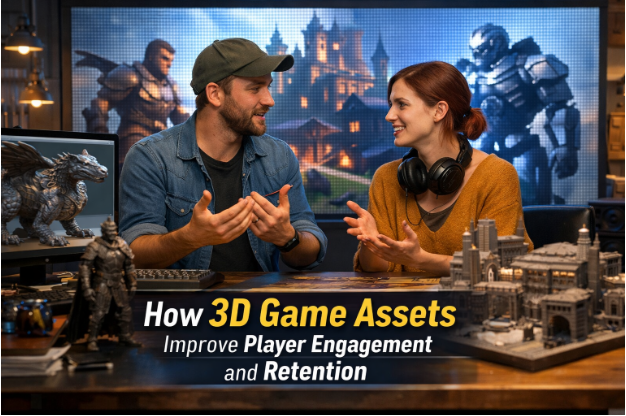
All successful games share one common factor: they immerse the players in the experience and thus, even after the very first play, the experience is still deep and lasting.
There is no doubt that game mechanics, story, and music can all keep the players’ attention, but most of the time, it is the graphics that leave the first impression.
Outstanding 3D game assets not only make a world look nice; they control the players’ actions and facilitate their choice to stay in it.
When the environment reads well, characters feel animated, props comply, and players want nothing more than to push the curtain of discovery further. This curiosity and comfort play huge roles when it comes to retention in the long run.
Creating Worlds That Feel Alive
Every well-designed world stimulates players to play ahead. Rich textures, carefully designed illumination, and expressive shapes bestow personalities to their environments.
Players become engaged when they feel part of a place that is imbued with specially made features, a very generic place from which they can draw a richer connection. The best 3D game assets make places feel habituated. Every nook already becomes worth exploring.
Building Characters Players Care About
Characters usually form the emotional anchor of any game, and such images can strengthen that bond even more. Solid modelling brings in characters’ lifelines as seen in their expressive silhouettes and realistic animations.
Players are usually more affected when they see how the expressions on a model’s face manifest as subtle shifts of weight during its movements. These characters communicate in tone, without speaking; players thus associate themselves with the experience.
Players do come to play, but they also come to get that strong narrative tie behind it when a character looks memorable.
Improving Gameplay Clarity
It is about how easily players understand their surroundings as much as it is about aesthetics. Visual clarity impacts every aspect of life, from navigation to combat. Good models and clear silhouettes do the trick, and environmental markers don’t overwhelm them, nudge them toward the right decisions.
Good 3D game assets assist in gameplay while still making objectives clear and interactions predictable. More knowledge of the reliability of what is being looked at and how it acts increases the time the player is kept engrossed and lessens the frustration experienced.
Strengthening Emotional Impact
There is power in visual storytelling. The difference between seeing a rusted weapon and a polished one is history. A broken corridor feels different from a pristine hallway. With the help of assets, artists convey history, mood, and tension without a single line of dialogue.
This emotional layering tends to go much further regarding the experience, and deep experiences keep players holding fast in the same spot. Sights evoke something: warmth, pain, wonderings, jolts of euphoria, memories.
This will create occasions that players will remember. The game will stay with the player psychologically when they are not actually playing it, increasing retention.
Encouraging Exploration Through Visual Rewards
Games typically attract players towards exploration. Hidden rooms, rare items, and wonderful vistas act as rewards. If the visuals feel rewarding, then it is a natural thing for players to want to explore more. A well-designed landscape, an incredible-looking enemy, and an awe-inspiring treat reward eyes.
Well-made assets create a solid loop of exploratory satisfaction through which the player grabs their attention: they see something interesting, walk toward it, uncover more details, and keep themselves engaged for longer.
Supporting Smooth Performance
Seamless game performance is very important in keeping engagement levels high. Beautiful graphics are often disregarded if one cannot play the game anymore. This calls for intelligent asset creation.
From efficient mesh optimization to clean texture application and mindful setup, lighter performance can be ensured on a greater variety of hardware. Many studios partner with the service providers who offer 3D modeling services to strike a compromise between beauty and efficiency.
If they can create performance-oriented 3D game assets, the whole gameplay loop reads tighter and feels better. These two aspects alone keep players for longer. Nothing interrupts their immersion.
Adapting Visuals to Player Style
Modern games frequently feature customizable characters, skins, weapons, or environments. The visual options that they present to the players give them a feeling of ownership, thereby enhancing retention in a most straightforward manner.
If players have the possibility to personalize their avatar or the setting, they will be more emotionally attached to the game. These players will experience the temptation to come back, to play with their creations, and to show them off to others.
Many successful live service and multiplayer titles have succeeded on this straightforward notion. Players stay when connected to their visual identity.
Conclusion
The top-notch 3D game assets not only improve the graphical quality to the highest standards but also impact the players’ emotions, movements, discoveries, and interactions with the game setting.
When the visuals generate good sentiments, make the game rules easily understandable, are friendly to the users, and come with big rewards, then the player’s involvement in the game will increase automatically. And when a game is memorable visually and mechanically, players keep coming back.